How Surface Prep Affects Coating Performance in Chicago’s Climate
For facility managers and project managers overseeing industrial coating work in the Chicago area, the conversation about coating performance almost always starts in the wrong place. It starts with the coating itself: the chemistry, the mil thickness, the warranty. What it should start with is the surface underneath.
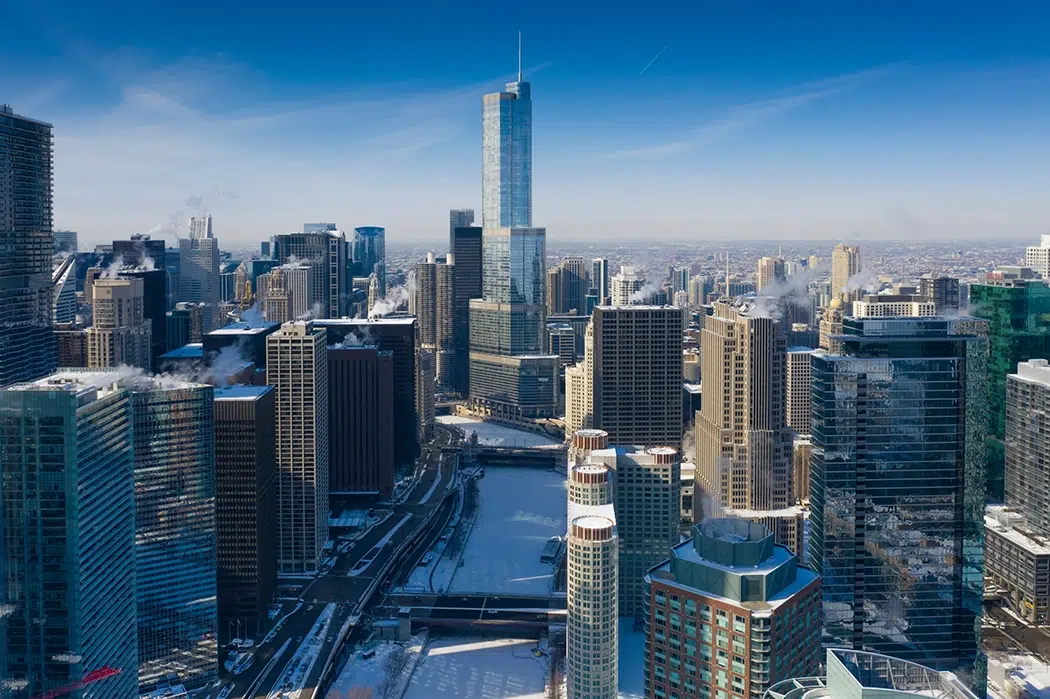
Surface preparation is the single greatest variable in how long an industrial coating lasts. In a climate as unpredictable as Chicago's, where temperatures can swing 100 degrees Fahrenheit between seasons, where humidity fluctuates dramatically, and where freeze-thaw cycles assault exposed steel and concrete repeatedly each winter, a coating applied over inadequate prep is already failing before the crew packs up.
WHAT CHICAGO’S CLIMATE ACTUALLY DEMANDS FROM A COATING SYSTEM
Chicago's weather doesn't ask much of a coating in isolation. What it demands is adhesion that holds through constant mechanical stress. Steel expands and contracts with temperature. Concrete absorbs moisture and releases it under pressure. When a coating is bonded tightly to a properly prepared surface, it moves with the substrate, flexing and holding through each cycle. When it isn't, it acts as a rigid shell over a moving substrate, and the physics of that situation are unforgiving.
The failure modes are predictable: delamination at the edges, blistering caused by moisture trapped beneath the film, and creep corrosion that spreads outward from any small breach in the coating. None of these are random. They trace back, almost without exception, to what the surface looked like before the first coat was applied.
THE ROLE OF BLAST PROFILE AND CLEANLINESS ON STEEL
On steel structures, including tanks, structural members, bridge components, and industrial equipment, the conversation starts with SSPC cleanliness grades. An SP-6 commercial blast and an SP-10 near-white blast produce dramatically different anchor profiles and different levels of contamination removal. In Chicago's environment, where airborne chlorides from road salt settle onto virtually every exposed surface, that distinction matters.
Soluble salts left on a steel surface before coating are one of the most reliable predictors of early coating failure. They draw moisture osmotically through even a well-applied coating film, creating blisters that eventually break the bond entirely. In a climate where freeze-thaw action then gets into those blisters, the rate of deterioration accelerates sharply. This is why media selection matters as much as it does.
Garnet is a particularly effective abrasive for steel work where deep contamination removal is the priority. Its angular geometry drives into surface cavities, pits caused by existing corrosion, weld seams, and crevices, physically removing rust, salts, mill scale, and residue that softer abrasives leave behind. Garnet also produces low ambient dust, which matters both for operator safety and for reducing particulate recontamination of the freshly blasted surface. For confined-space work like storage tanks and pipelines, this dust profile is often the deciding factor in media selection.
For projects requiring a more controlled surface profile, etching for coating adhesion without aggressive metal removal, aluminum oxide provides a precise alternative. Available in multiple grits, it allows the profile to be matched to the coating system's specific requirements. Its recyclability also makes it practical for enclosed blast operations.
COAL SLAG, GLASS BEAD, AND THE ECONOMICS OF ABRASIVE SELECTION
Coal slag, sometimes called Black Beauty, remains one of the most widely used abrasives for general steel preparation in industrial settings. It is economical, aggressive enough for most coating systems, and available in a range of grits for profile control. For large-area structural steel prep where efficiency drives cost, coal slag delivers consistent, reliable results.
Glass bead occupies a different part of the performance envelope. Where coal slag is used for aggressive cleaning and profile creation, glass bead is a finishing abrasive, used where a smoother surface is needed or where the goal is surface brightening and light cleaning rather than heavy coating removal. In maintenance contexts, where a coating has degraded but the underlying steel is still sound, glass bead can condition the surface for recoating without introducing a profile that would require additional fill.
Glass bead offers a useful middle ground. Made from 100% recycled material, it works well as a semi-hard abrasive for paint stripping, graffiti removal, and commercial restoration on masonry and other substrates. It is compatible with slurry, vapor, and dry-blast equipment, which adds operational flexibility depending on site conditions and containment requirements.
CONCRETE AND MASONRY: A DIFFERENT SET OF PREP VARIABLES
Concrete surfaces present a distinct set of challenges. Laitance, the weak surface layer that forms during curing, must be removed before any coating system can achieve proper bond. Carbonation, contamination left by previous coatings or sealers, and moisture content all factor into adhesion outcomes. In Chicago's climate, concrete that has undergone repeated freeze-thaw cycles often has micro-cracking and surface deterioration that changes the effective profile entirely.
Hydroblasting, high-pressure water blasting, is particularly well-suited to concrete prep in these conditions. Water does not introduce new contamination, and at sufficient pressure it removes laitance, curing compounds, biological growth, and existing coating residue without generating abrasive waste that must be collected and disposed of. For surfaces near storm drains, food processing environments, or sensitive vegetation, this carries practical and environmental advantages.
Dry ice blasting is another option that applies well in specialized concrete and interior environments. It removes contaminants through thermal shock and sublimation, leaving no blast media residue behind because the CO2 simply evaporates. This makes it well-suited to facilities where cleanliness is paramount and where traditional blast media would create unacceptable cleanup or disposal challenges.
WHEN THE SUBSTRATE NEEDS A LIGHTER TOUCH
Not every coating project involves bare steel or industrial-grade concrete. Chicago has a substantial inventory of older wood-frame buildings, log structures, historic masonry, and mixed-material facades that require protective coatings and prep that will not damage what is underneath.
Walnut shell blasting is the standard approach for wood surfaces where coating removal is required without damaging the substrate. The angular geometry of crushed walnut shells provides enough cutting action to lift coatings, but the material is soft enough that it will not raise grain or damage the wood fiber beneath. This makes it appropriate for log homes, decorative woodwork, and historical structures where surface integrity is as important as the prep result.
Corn cob media follows a similar logic. It is organic, biodegradable, and hard enough to remove multi-layered paint and enamel on wood and other organic surfaces without introducing damage. Its low dust generation compared to many conventional media makes it operationally efficient, with less containment staging and faster cleanup. For interior work in occupied or sensitive environments, this is a meaningful operational advantage. Corn cob is also non-sparking, which makes it a practical choice near electrical components, generators, and switchgear.
Baking soda blasting rounds out the soft-media options for the most delicate substrates. It removes surface contamination and light coatings through a combination of mechanical action and chemical reaction, and because it is water-soluble, cleanup is straightforward. It is frequently used in restoration contexts, fire and smoke damage remediation, and situations where substrate preservation is the primary concern.
COMMON SURFACE PREP MEDIA AND THEIR APPLICATIONS
Selecting the right abrasive is an engineering decision, not an afterthought. Here is a quick reference for how each media type aligns with common Chicago-area project conditions:
COAL SLAG (BLACK BEAUTY)
General structural steel prep, large surface areas, aggressive profile creation
GARNET
Heavy industrial steel, tanks, pipelines, confined spaces, deep contamination removal
ALUMINUM OXIDE
Etching and surface finishing on metal and glass, recyclable for enclosed blast rooms
CORN COB
Multi-layered paint removal on wood and organic materials, interior and electrical environments
HYDROBLASTING
Concrete and masonry, laitance removal, environmentally sensitive jobsites
CRUSHED GLASS
Paint and coating removal, graffiti remediation, masonry, and commercial restoration
GLASS BEAD
Light cleaning and surface conditioning, maintenance recoats on sound steel
WALNUT SHELL
Wood surfaces, log structures, decorative and historical substrates
BAKING SODA
Delicate surfaces, fire and smoke remediation, water-soluble residue cleanup
DRY ICE BLASTING
Interior surfaces, zero-residue requirements, sensitive facilities, and food processing environments
CONNECTING PREP DECISIONS TO LONG-TERM COATING PERFORMANCE
 The practical implication for facility owners and project managers is straightforward: the prep specification is not a line item to economize on. It is the variable that most directly determines how long the coating system performs.
A coating system applied over inadequately prepared steel in Chicago can show visible failure within 18 to 24 months, with blistering, rust-through at the edges, and delamination on horizontal surfaces where water pools and freeze-thaw action is most concentrated. The same coating system applied over properly blasted and cleaned steel, with a profile matched to the coating's specified requirements, can routinely reach or exceed the system's rated service life.
The math on this is not subtle. Prep costs are a fraction of the total coating project cost, and they are the fraction most tightly correlated with outcome. When a coating fails early, the cost to mobilize, prepare, and recoat is not just the material and labor of the recoat. It includes lost facility time, potential substrate damage from the extended exposure period, and the original prep and coating cost that produced no lasting value.
In a climate like Chicago's, where the environment consistently works against coating systems, getting the prep right the first time is the highest-return investment in the overall project. The media selection, the cleanliness standard, the surface profile: these are engineering decisions that belong at the front of the project scope, alongside the coating specification itself.
WORKING WITH THE RIGHT PREP PARTNER IN THE CHICAGO MARKET
Blast It Clean provides industrial surface preparation services across the Chicago area, with media options that cover the full range of substrate types and project environments. For heavy industrial steel work or delicate, historically sensitive surfaces, each project is scoped and specified to match the substrate, the environment, and the coating system's requirements.
Understanding how Chicago's climate interacts with coating systems is part of our approach to every project. Surface preparation is not just a step in the process. In this market, it is the foundation that everything else depends on.
CONTACT US
If you are planning a coating project in the Chicago area and want to discuss surface preparation options, the team at Blast It Clean is ready to help.
We work with facility owners, project managers, and coating contractors to develop prep scopes that match the substrate, the environment, and the performance expectations of the coating system. Reach out to us directly to schedule a site assessment or get answers to project-specific questions. Getting the right information early in the planning process is the most effective way to protect your investment long term.