
Surface Prep Inside Chicago Warehouses During Summer Work
There's a window every summer where warehouse managers try to knock out deferred maintenance: repaint worn floor markings, restore beat-up columns, strip failing coatings off walls before the rust spreads any further. The weather cooperates. Lease renewals are coming up. New tenants want interiors that look well cared for.
But anyone who's managed a warehouse in Chicago knows that "summer downtime" is rarely downtime. Trucks are still running. Inventory is moving. Your third shift doesn't disappear because a contractor is scheduled. And the heat inside a metal-framed building near the lake in July isn't exactly comfortable for workers or for coatings.
Warehouse surface preparation in Chicago during summer is doable, and when it's done right, it buys you years of low maintenance. But it requires a different level of planning than an exterior job or an empty building. Here's what that actually looks like.
THE INTERIOR ENVIRONMENT IN SUMMER IS ITS OWN CHALLENGE
Exterior crews deal with heat and humidity. Interior crews deal with all of that, plus limited airflow, confined spaces, and the ongoing operations happening twenty feet from the blast zone.
Steel columns, concrete block walls, and brick absorb heat differently. By mid-afternoon in an unventilated bay, surface temperatures can spike well above ambient air temps, which is enough to affect how coatings cure if work is done at the wrong time of day. Proper industrial warehouse blasting accounts for this. Timing the work to cooler morning hours, staging in shaded bays when possible, and monitoring surface temperature before coating goes down are standard practice on well-run projects.

Moisture is a separate issue. Chicago summers bring humidity that fluctuates day to day. Surfaces need to be blasted and coated within a tight window before flash rust develops. This isn't a problem that shows up on day one. It shows up a year later when coatings start peeling from a substrate that looked clean but had early surface oxidation locked underneath.
DUST CONTROL IS NOT OPTIONAL IN AN ACTIVE FACILITY
If there's a single issue that derails interior blasting projects in occupied warehouses, it's dust. Dry blasting generates significant particulate. In an empty building, that's manageable. In a facility with open rack storage, active conveyors, forklifts moving through, or food-adjacent operations, uncontrolled dust isn't just a nuisance. It's a liability.
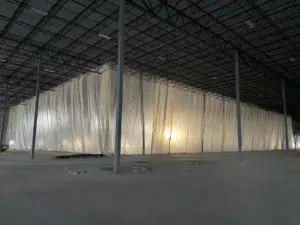 Dust-controlled blasting in Chicago warehouse environments requires real containment: plastic sheeting, negative air pressure where feasible, physical barriers between the blast zone and active areas, and air filtration equipment to manage what escapes. It also requires communication. Warehouse staff need to know which zones are active, where access is restricted, and what the cleanup sequence looks like before they're back in that area.
We've worked in facilities where a pressurized containment setup allowed blasting on one side of a bay while pallet movement continued thirty feet away. That doesn't happen without proper planning and barrier systems. And it doesn't happen at all if the contractor treats containment as an afterthought.
SCHEDULING AROUND A WAREHOUSE THAT DOESN’T STOP
Most Chicago warehouses aren't seasonal operations. They run continuously, which means the "ideal" scheduling window of a fully empty building with no constraints simply doesn't exist. What you actually have is a floor plan with dead zones, shift changes, staging areas that move week to week, and dock doors that are in use at almost any hour.
Effective warehouse maintenance Chicago contractors work around this by treating scheduling as part of the scope, not an afterthought. Before the first blast nozzle shows up, a good crew walks the facility, identifies which bays or walls can be isolated, and builds a phased plan that sequences work around your operations rather than shutting them down.
A common approach for large facilities is zone blasting, where crews work in sections while maintaining a clear separation between active and inactive areas. This extends the project timeline compared to working on an empty building, but it keeps your operation running. For most clients, that tradeoff is exactly right.
Night and weekend work is another option, though it comes with its own logistics. Dust control still applies. Temperature and humidity still matter. And your facility staff still needs to know what's happening and when cleanup occurs before the day shift arrives.
WHAT PROPER INTERIOR SURFACE PREP ACTUALLY INVOLVES
Interior sandblasting in Chicago warehouses typically involves abrasive blasting of steel columns, brick walls, concrete block, exposed wood ceilings, or metal decking, depending on what the building is made of and what condition it's in.
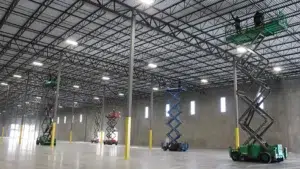 The objective is always the same: get down to clean substrate, remove old failing coatings, rust, contaminants, and anything else that would prevent the new coating system from bonding properly. In older Chicago warehouse buildings, that often means multiple layers of old paint, years of accumulated grime, and in some cases coatings that were applied over surfaces that were never properly cleaned to begin with.
We completed an interior restoration project where the entire facility had painted brick walls and wood ceilings that required ongoing repainting every few years. The paint had been applied over decades without adequate prep, and the cycle of failure had become predictable and expensive. The goal was to blast down to bare brick and natural wood, remove all the accumulated layers, and leave the surfaces in a condition that simply didn't need painting again.
After blasting, every interior surface was pressure-washed to remove residual dust from the dry blasting process. What was left was natural brick and clean wood that looked significantly better than the layers of chipping paint it had replaced, and it no longer required a repainting schedule going forward. That's the outcome proper prep delivers. Not just a better-looking surface, but a surface that stops costing money.
THE COST MATH OVER FIVE YEARS
Facilities that cut corners on surface preparation consistently pay for it later. A coating system that should last ten to fifteen years begins failing in three to five when the substrate wasn't properly prepared. That means another shutdown, another contractor mobilization, another round of blasting and recoating, all earlier than it should have been.
The math compounds. The second project costs more than the first because now there's more deterioration to address. Corrosion has spread under the failing paint. In some cases, structural steel or concrete has degraded enough that repair enters the picture before coating does.
In active warehouse environments, the hidden cost is downtime. Every time a maintenance project interrupts operations, it affects throughput, scheduling, and labor. The goal of proper surface preparation isn't just to make coatings last longer. It's to extend the intervals between maintenance projects so your facility operates with fewer interruptions over time.
WHAT TO LOOK FOR IN A CONTRACTOR
Interior blasting inside an active Chicago warehouse is not a job for crews that work primarily on exterior or vacant structures. The variables are different. The containment requirements are different. The coordination with your operations staff is a real part of the work, not a courtesy.
When evaluating contractors for warehouse surface preparation in Chicago, these are the questions worth asking before anyone shows up with equipment:
EXPERIENCE IN OCCUPIED FACILITIES
Have they completed interior blasting projects inside functioning warehouses, or do their references come primarily from exterior or vacant-building work?
CONTAINMENT APPROACH
What does their dust control setup actually look like? Plastic sheeting and a shop vac is not the same as a negative-pressure containment system with air filtration.
CLEANUP BEFORE HANDOFF
What does the post-blast cleanup process involve, and how do they verify a zone is ready before your staff returns to it?
SURFACE TEMPERATURE AND MOISTURE MONITORING
Do they check conditions before coating goes down, or do they apply on a fixed schedule regardless of conditions?
SEQUENCING AND PHASING
Can they work in zones around your active operations, and do they have a documented plan for which areas are restricted and when?
The answers will tell you quickly if a crew has actually managed these situations or if they're adapting exterior habits to an environment that requires something more.
READY TO GET IT DONE THIS SUMMER?
If you're planning interior surface work at a Chicago-area warehouse or industrial facility, Blast It Clean is ready to help. We work with manufacturing facilities, food processing operations, water treatment plants, and warehouses where the prep has to be done right, around your schedule, inside your operating environment, without disrupting the work that can't stop.
Contact us today to schedule a facility walkthrough and get a realistic scope for your project. The sooner you're in the schedule, the more flexibility you have before peak summer heat sets in.
Reach out to the Blast It Clean team and let's talk through what your facility actually needs.